Download
Download this notebook: variable_selection_zero_basis.ipynb!
Model Selection: Cross-validate over Inputs#
When modeling neural activity with multiple inputs, you may want to determine which inputs are necessary. The Zero basis acts as a placeholder that contributes no features, allowing you to systematically test different input combinations.
Load data#
We’ll use place cell data to test whether position, theta phase, or both are needed to predict neural responses. See the place cells tutorial for details on this dataset.
import nemos as nmo
import pynapple as nap
from sklearn.model_selection import cross_val_score

# Fetch data
path = nmo.fetch.fetch_data("Achilles_10252013.nwb")
data = nap.load_file(path)

# Get spikes, position, and theta phase
spikes = data["units"].getby_category("cell_type")["pE"]
position = data["position"].restrict(data["trials"])
theta = data["theta_phase"]

# Select one neuron and bin spikes
neuron = spikes[82]
bin_size = 0.1
counts = neuron.count(bin_size, ep=position.time_support)

# Align position and theta to spike counts
position = position.interpolate(counts, ep=counts.time_support)
theta = theta.interpolate(counts, ep=counts.time_support)
Downloading file 'Achilles_10252013.nwb' from 'https://osf.io/download/hu5ma/' to '/home/docs/.cache/nemos'.
Cross-validate over inputs#
We’ll use scikit-learn’s cross-validation to compare models with different input combinations.
from sklearn.model_selection import GridSearchCV
from sklearn.pipeline import Pipeline
import numpy as np

# Define complete basis configurations
position_basis = nmo.basis.BSplineEval(n_basis_funcs=10)
theta_basis = nmo.basis.CyclicBSplineEval(n_basis_funcs=8)

# Use Zero as placeholder for excluded inputs
basis_both = position_basis + theta_basis
basis_position = position_basis + nmo.basis.Zero()
basis_theta = nmo.basis.Zero() + theta_basis

basis_both.label = "both"
basis_position.label = "position"
basis_theta.label = "theta"


# Set up pipeline
pipeline = Pipeline([
    ("basis", basis_both.to_transformer()),
    ("glm", nmo.glm.GLM(solver_name="LBFGS"))
])

# Test different input combinations
param_grid = {
    "basis__basis": [
        basis_both,     # position + theta
        basis_position, # position only
        basis_theta     # theta only
    ],
}

# Run grid search
gridsearch = GridSearchCV(pipeline, param_grid=param_grid, cv=5)
X = np.column_stack([position, theta])
gridsearch.fit(X, counts.d)
gridsearch
GridSearchCV(cv=5,
             estimator=Pipeline(steps=[('basis',
                                        Transformer('both': AdditiveBasis(
    basis1=BSplineEval(n_basis_funcs=10, order=4),
    basis2=CyclicBSplineEval(n_basis_funcs=8, order=4),
))),
                                       ('glm',
                                        GLM(inverse_link_function=<function exp at 0x764a7494e480>, observation_model=PoissonObservations(), regularizer=UnRegularized(), solver_kwargs={}, solver_name='LBFGS'))]),
             param_grid={'basis__basis': [AdditiveBasis(BSplineEval=BSplineEval(n_basis_funcs=10), CyclicBSplineEval=CyclicBSplineEval(n_basis_funcs=8), label='both'),
                                          AdditiveBasis(BSplineEval=BSplineEval(n_basis_funcs=10), Zero=Zero(), label='position'),
                                          AdditiveBasis(CyclicBSplineEval=CyclicBSplineEval(n_basis_funcs=8), Zero=Zero(), label='theta')]})
In a Jupyter environment, please rerun this cell to show the HTML representation or trust the notebook. On GitHub, the HTML representation is unable to render, please try loading this page with nbviewer.org.
Parameters
Fitted attributes
Parameters
| label | 'position' | |
| BSplineEval__bounds | None | |
| BSplineEval__fill_value | nan | |
| BSplineEval__label | 'BSplineEval' | |
| BSplineEval__n_basis_funcs | 10 | |
| BSplineEval__order | 4 | |
| BSplineEval | BSplineEval(n...s=10, order=4) | |
| Zero__label | 'Zero' | |
| Zero | Zero() |
Parameters
| observation_model | PoissonObservations() | |
| inverse_link_function | <function exp...x764a7494e480> | |
| regularizer | UnRegularized() | |
| solver_name | 'LBFGS' | |
| solver_kwargs | {} | |
| regularizer_strength | None |
Fitted attributes
| Name | Type | Value |
|---|---|---|
| aux_ | NoneType | None |
| coef_ | ArrayImpl[float64](10,) | Array([ 0.697...dtype=float64) |
| dof_resid_ | ArrayImpl[float64](1,) | Array([1916.], dtype=float64) |
| intercept_ | ArrayImpl[float64](1,) | Array([-2.521...dtype=float64) |
| scale_ | ArrayImpl[float64](1,) | Array([1.], dtype=float64) |
| solver_state_ | OptimistixAdapterState | OptimistixAda...k_bool[] ) ) |
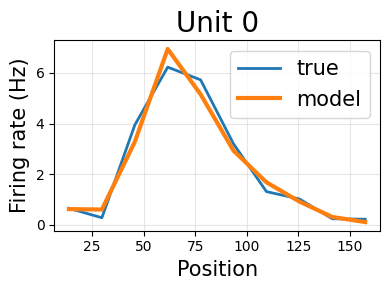
The most predictive encoding model for this neuron includes position only. Below the comparison of the tuning curves.
import matplotlib.pyplot as plt

# Compute and plot tuning curves
tc_position = nap.compute_tuning_curves(
    neuron, position, bins=10, feature_names=["position"]
)
tc_position_model = nap.compute_tuning_curves(
    gridsearch.predict(X) * X.rate, position, bins=10, feature_names=["position"]
)

# Plot tuning curves
fig, ax = plt.subplots(1, 1, figsize=(4, 3))
tc_position.squeeze().plot(ax=ax, linewidth=2, markersize=6, label="true")
tc_position_model.squeeze().plot(ax=ax, linewidth=3, markersize=6, label="model")
ax.set_ylabel('Firing rate (Hz)', fontsize=15)
ax.set_xlabel('Position', fontsize=15)
ax.set_title(f'Unit {tc_position.coords["unit"].values[0]}', fontsize=20)
ax.grid(True, alpha=0.3)
plt.legend(fontsize=15)
plt.tight_layout()
/home/docs/checkouts/readthedocs.org/user_builds/nemos/envs/latest/lib/python3.12/site-packages/pynapple/core/utils.py:198: UserWarning: Converting 'd' to numpy.array. The provided array was of type 'ArrayImpl'.
  warnings.warn(