

nemos.basis.FourierEval#
- class nemos.basis.FourierEval(frequencies, ndim=1, bounds=None, frequency_mask='no-intercept', label='FourierEval')[source]#
Bases:
EvalBasisMixin,FourierBasisN-dimensional Fourier basis for feature expansion.
This class generates a set of sine and cosine basis functions defined over an
n-dimensional input space. The basis functions are constructed from a Cartesian product of frequencies specified for each input dimension. Each selected frequency combination contributes two basis functions (cosine and sine), except for the all-zero frequency (DC component), which contributes only a cosine term.The class supports flexible frequency specification (integers, ranges, or arrays per dimension) and optional masking to include or exclude specific frequency combinations.
- Parameters:
frequencies –
Frequency specification(s).
Single specification (broadcasted to all dimensions when
ndim > 1):Per-dimension container:
ndim – Dimensionality of the basis. Default is 1.
bounds –
Period bounds for each dimension. Unlike other basis classes where bounds define a valid domain (with out-of-bounds samples filled with NaN), for the Fourier basis the bounds define the period of the basis functions. Samples outside these bounds are still valid and will be evaluated using the periodic nature of the basis.
tuple:(low, high)of floats: applies to all dimensions.listoftuple:[(low, high), ...], one tuple per dimension, length must matchndim.None: the period is inferred from the input data (minimum to maximum values).
In all cases,
lowmust be strictly less thanhigh, and values must be convertible to floats.frequency_mask –
Optional mask specifying which frequency components to include. Can be:
Literal: either"no-intercept"- default - which drops the 0-frequency DC term, or"all"which keeps all the frequencies - equivalent toNone. The default excludes the intercept because these basis objects are most commonly used to generate design matrices for NeMoS GLMs, which already include an intercept term by default, making an additional intercept in the design matrix redundant.Array-like of integers {0, 1} or booleans: Selects frequencies to keep (1/True) or exclude (0/False). Shape must match the number of available frequencies for each dimension.
Callable: A function applied to each frequency index (one index per dimension), returning a single boolean or {0, 1} indicating whether to keep that frequency.None: All frequencies are kept.
Values must be 0/1 or boolean. Callables must return a single boolean or {0, 1} value for each frequency coordinate.
label – Descriptive label for the basis (e.g., to use in plots or summaries).
Notes
If
frequency_maskis provided, only the selected frequency combinations are used to build the basis.The output of
compute_featurescontains both cosine and sine components for each active frequency combination, except that the all-zero frequency includes only a cosine term.When a
tupleis provided as a frequency, it is interpreted as a single range specification. Tuples that are not exactly a 2-element tuple of non-negative integers are invalid.
Examples
>>> import numpy as np
>>> from nemos.basis import FourierEval
>>> rng = np.random.default_rng(0)
1D: basic usage
>>> n_freq = 5
>>> fourier_1d = FourierEval(n_freq)
>>> # cos at 0..4 (5) + sin at 1..4 (4) = 9
>>> fourier_1d.n_basis_funcs
8
>>> x = rng.normal(size=8)
>>> X = fourier_1d.compute_features(x)
>>> X.shape  # (n_samples, n_basis_funcs)
(8, 8)
2D: unmasked grid of frequency pairs
>>> fourier_2d = FourierEval(n_freq, ndim=2)
>>> # (5*5 frequency pairs) * 2 (cos+sin) - 1 (no sine at DC) = 49
>>> fourier_2d.n_basis_funcs
48
>>> x, y = rng.normal(size=(2, 6))
>>> X = fourier_2d.compute_features(x, y)
>>> X.shape
(6, 48)
2D: masking with an array (drop 3 pairs)
>>> mask = np.ones((5, 5))
>>> # drop 3 frequency pairs, including DC term (0,0)
>>> mask[[0, 0, 1], [0, 1, 2]] = 0
>>> fourier_2d_masked = FourierEval(
...     n_freq,
...     ndim=2,
...     frequency_mask=mask
... )
>>> # (5*5-3 frequency pairs) * 2 (cos+sin) = 44
>>> fourier_2d_masked.n_basis_funcs
44
2D: masking with a callable
>>> # keep pairs inside a circle of radius 3.5 in frequency space
>>> keep_circle = lambda fx, fy: (fx**2 + fy**2) ** 0.5 < 3.5
>>> fourier_2d_funcmask = FourierEval(
...     n_freq,
...     ndim=2,
...     frequency_mask=keep_circle
... )
>>> fourier_2d_funcmask.n_basis_funcs
25
Explicit frequency specifications
>>> # mix forms per-dimension: an explicit array
>>> # and an inclusive tuple (low, high)
>>> fourier_mixed = FourierEval(
...     frequencies=[np.arange(3), (1, 4)],
...     ndim=2
... )
>>> # (3*3 frequency pairs) * 2 (cos+sin) = 18; no DC term (0, 0)
>>> fourier_mixed.n_basis_funcs
18
Attributes
Returns bounds, as provided.
Frequencies for the basis.
Get the frequency mask for the Fourier basis.
Expected per-sample input shape.
Whether the basis is intrinsically complex.
Label for the basis.
The frequencies after the masking is applied.
Number of basis functions.
Number of features returned by the basis.
The dimensionality of the basis.
- __init__(frequencies, ndim=1, bounds=None, frequency_mask='no-intercept', label='FourierEval')[source]#
Methods
__init__(frequencies[, ndim, bounds, ...])compute_features(*xi)Evaluate basis at sample points.
evaluate(*sample_pts)Evaluate the Fourier basis at the sample points.
evaluate_on_grid(*n_samples)Evaluate the basis set on a grid of equi-spaced sample points.
get_params([deep])From scikit-learn, get parameters by inspecting init.
set_input_shape(*xi)Set the expected input shape for the basis object.
set_params(**params)Set params handling correctly the frequencies and their mask.
setup_basis(*xi)Set all basis states.
split_by_feature(x[, axis])Decompose an array along a specified axis into sub-arrays based on the number of expected inputs.
Turn the Basis into a TransformerBasis for use with scikit-learn.
- __add__(other)#
Add two Basis objects together.
- Parameters:
other (
BasisMixin) – The other Basis object to add.- Returns:
The resulting Basis object.
- Return type:
- classmethod __init_subclass__(**kwargs)#
Set the
set_{method}_requestmethods.This uses PEP-487 [1] to set the
set_{method}_requestmethods. It looks for the information available in the set default values which are set using__metadata_request__*class attributes, or inferred from method signatures.The
__metadata_request__*class attributes are used when a method does not explicitly accept a metadata through its arguments or if the developer would like to specify a request value for those metadata which are different from the defaultNone.References
- __iter__()#
Make basis iterable. Re-implemented for additive.
- __len__()#
Return the number of additive basis.
- __mul__(other)#
Multiply two Basis objects together.
- __pow__(exponent)#
Exponentiation of a Basis object.
Define the power of a basis by repeatedly applying the method __multiply__. The exponent must be a positive integer.
- Parameters:
exponent (
int) – Positive integer exponent- Return type:
BasisMixin- Returns:
The product of the basis with itself “exponent” times. Equivalent to
self * self * ... * self.- Raises:
TypeError – If the provided exponent is not an integer.
ValueError – If the integer is zero or negative.
- __sklearn_clone__()#
Clone the basis while preserving attributes related to input shapes.
This method ensures that input shape attributes (e.g., _input_shape_product, _input_shape_) are preserved during cloning. Reinitializing the class as in the regular sklearn clone would drop these attributes, rendering cross-validation unusable.
- Return type:
- property bounds: List[Tuple[float, float]] | Tuple[float, float] | None#
Returns bounds, as provided.
- compute_features(*xi)[source]#
Evaluate basis at sample points.
The basis is evaluated at the locations specified in the inputs. For example,
compute_features(np.array([0, .5]))would return the array:b_1(0) ... b_n(0) b_1(.5) ... b_n(.5)
where
b_iis the i-th basis.- Parameters:
*xi (ArrayLike) – The input samples over which to apply the basis transformation. The samples can be passed as multiple arguments, each representing a different dimension for multivariate inputs.
- Return type:
FeatureMatrix
- Returns:
A matrix with the transformed features.
Examples
>>> import numpy as np
>>> from nemos.basis import FourierEval
>>> # Generate data
>>> num_samples = 1000
>>> X = np.random.normal(size=(num_samples, ))  # raw time series
>>> basis = FourierEval(10)
>>> features = basis.compute_features(X)  # basis transformed time series
>>> features.shape
(1000, 18)
- evaluate(*sample_pts)[source]#
Evaluate the Fourier basis at the sample points.
- Parameters:
sample_pts (NDArray) – Spacing for basis functions, holding elements on interval [0, 1]. sample_pts is a n-dimensional (n >= 1) array with first axis being the samples, i.e. sample_pts.shape[0] == n_samples.
- Raises:
ValueError – If the sample provided do not lie in [0,1].
- Return type:
NDArray
Examples
>>> import numpy as np
>>> from nemos.basis import FourierEval
>>> basis = FourierEval(4)
>>> out = basis.evaluate(np.random.randn(100, 5, 2))
>>> out.shape
(100, 5, 2, 6)
- evaluate_on_grid(*n_samples)[source]#
Evaluate the basis set on a grid of equi-spaced sample points.
- Parameters:
n_samples (
int) – The number of points in the uniformly spaced grid. A higher number of samples will result in a more detailed visualization of the basis functions.- Return type:
Tuple[NDArray, NDArray]- Returns:
X – Array of shape (n_samples,) containing the equi-spaced sample points where we’ve evaluated the basis.
basis_funcs – Fourier basis functions, shape (n_samples, n_basis_funcs)
Examples
>>> import numpy as np
>>> import matplotlib.pyplot as plt
>>> from nemos.basis import FourierEval
>>> n_frequencies = 5
>>> fourier_basis = FourierEval(n_frequencies)
>>> sample_points, basis_values = fourier_basis.evaluate_on_grid(100)
>>> plt.plot(sample_points, basis_values)
[<matplotlib.lines.Line2D object at ...
>>> plt.show()
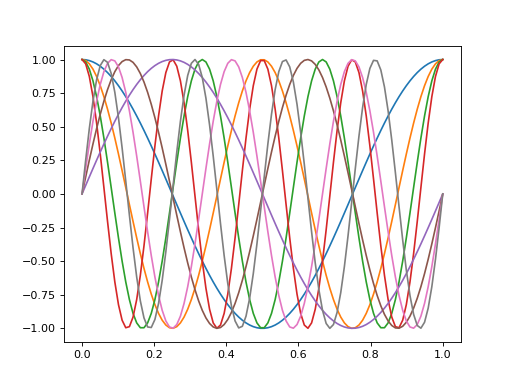
Fig. 21 FourierEval#
- property frequencies: List[Array]#
Frequencies for the basis.
- Returns:
A tuple of arrays with the fourier frequencies, one per dimension of the basis.
- property frequency_mask: Callable | Array | Literal['all', 'no-intercept']#
Get the frequency mask for the Fourier basis.
The frequency mask can be either:
a boolean array (or array-like of 0s and 1s) whose shape matches the number of frequencies along each input dimension, or
a callable with signature
frequency_mask(*freqs) -> bool(or 0/1) applied to each frequency tuple, ora string, either
"all", if all possible frequency combinations are included, or"no-intercept", if the intercept term is dropped (DC component).
- Returns:
The callable used to build the mask, the boolean JAX array mask, or
Noneif no mask is applied.
- get_metadata_routing()#
Get metadata routing of this object.
Please check User Guide on how the routing mechanism works.
- Returns:
routing – A
MetadataRequestencapsulating routing information.- Return type:
MetadataRequest
- get_params(deep=True)#
From scikit-learn, get parameters by inspecting init.
- Parameters:
deep – If True, will return the parameters for this estimator and contained subobjects that are estimators.
- Return type:
- Returns:
A dictionary containing the parameters. Key is the parameter name, value is the parameter value.
- property input_shape#
Expected per-sample input shape.
- Returns:
If inputs are shaped
(n_samples, *shape), returnsshape.
- property is_complex#
Whether the basis is intrinsically complex.
- Returns:
Trueif the basis is complex;Falseotherwise.
Notes
compute_features()always returns a real-valued design matrix. For complex bases (e.g.,FourierEval), the real and imaginary parts are returned as separate columns.
- property masked_frequencies: Array#
The frequencies after the masking is applied.
- Returns:
The masked frequencies, shape
(ndim, n_frequency_combinations).masked_frequencies[:, i]is the frequency combination for thei-th basis function.
- property n_output_features: int | None#
Number of features returned by the basis.
Notes
The number of output features can be determined only when the number of inputs provided to the basis is known. Therefore, before the first call to
compute_features, this property will returnNone. After that call, or after setting the input shape withset_input_shape,n_output_featureswill be available.
- property ndim#
The dimensionality of the basis.
- set_input_shape(*xi)[source]#
Set the expected input shape for the basis object.
This method configures the shape of the input data that the basis object expects.
xican be specified as an integer, a tuple of integers, or derived from an array. The method also calculates the total number of input features and output features based on the number of basis functions.- Parameters:
xi (
Union[int,tuple[int,...], NDArray]) –The input shape specification. - An integer: Represents the dimensionality of the input. A value of
1is treated as scalar input. - A tuple: Represents the exact input shape excluding the first axis (sample axis).All elements must be integers.
An array: The shape is extracted, excluding the first axis (assumed to be the sample axis).
- Raises:
ValueError – If a tuple is provided and it contains non-integer elements.
- Returns:
Returns the instance itself to allow method chaining.
- Return type:
self
Notes
All state attributes that depends on the input must be set in this method in order for the API of basis to work correctly. In particular, this method is called by
setup_basis, which is equivalent tofitfor a transformer. If any input dependent state is not set in this method, thencompute_features(equivalent tofit_transform) will break.Examples
>>> import nemos as nmo
>>> import numpy as np
>>> basis = nmo.basis.FourierEval(5)
>>> # Configure with an integer input:
>>> _ = basis.set_input_shape(3)
>>> basis.n_output_features
24
>>> # Configure with a tuple:
>>> _ = basis.set_input_shape((4, 5))
>>> basis.n_output_features
160
>>> # Configure with an array:
>>> x = np.ones((10, 4, 5))
>>> _ = basis.set_input_shape(x)
>>> basis.n_output_features
160
- set_params(**params)#
Set params handling correctly the frequencies and their mask.
- Parameters:
params (Any)
- setup_basis(*xi)#
Set all basis states.
This method corresponds sklearn transformer
fit. As fit, it must receive the input and it must set all basis states, i.e.kernel_and all the states relative to the input shape. The difference between this method and the transformerfitis in the expected input structure, where the transformerfitmethod requires the inputs to be concatenated in a 2D array, while here each input is provided as a separate time series for each basis element.- Parameters:
xi (NDArray) – Input arrays.
- Return type:
- Returns:
The basis with ready for evaluation.
- split_by_feature(x, axis=1)[source]#
Decompose an array along a specified axis into sub-arrays based on the number of expected inputs.
This function takes an array (e.g., a design matrix or model coefficients) and splits it along a designated axis.
How it works:
If the basis expects an input shape
(n_samples, n_inputs), then the feature axis length will betotal_n_features = n_inputs * n_basis_funcs. This axis is reshaped into dimensions(n_inputs, n_basis_funcs).If the basis expects an input of shape
(n_samples,), then the feature axis length will betotal_n_features = n_basis_funcs. This axis is reshaped into(1, n_basis_funcs).
For example, if the input array
xhas shape(1, 2, total_n_features, 4, 5), then after applying this method, it will be reshaped into(1, 2, n_inputs, n_basis_funcs, 4, 5).The specified axis (
axis) determines where the split occurs, and all other dimensions remain unchanged. See the example section below for the most common use cases.- Parameters:
x (NDArray) –
The input array to be split, representing concatenated features, coefficients, or other data. The shape of
xalong the specified axis must match the total number of features generated by the basis, i.e.,self.n_output_features.Examples:
For a design matrix:
(n_samples, total_n_features)For model coefficients:
(total_n_features,)or(total_n_features, n_neurons).
axis (
int) – The axis along which to split the features. Defaults to 1. Useaxis=1for design matrices (features along columns) andaxis=0for coefficient arrays (features along rows). All other dimensions are preserved.
- Raises:
ValueError – If the shape of
xalong the specified axis does not matchself.n_output_features.- Returns:
A dictionary where:
Key: Label of the basis.
Value: the array reshaped to:
(..., n_inputs, n_basis_funcs, ...)
- Return type:
Examples
>>> import numpy as np
>>> from nemos.basis import FourierEval
>>> from nemos.glm import GLM
>>> basis = FourierEval(6, label="one_input")
>>> X = basis.compute_features(np.random.randn(20,))
>>> split_features_multi = basis.split_by_feature(X, axis=1)
>>> for feature, sub_dict in split_features_multi.items():
...        print(f"{feature}, shape {sub_dict.shape}")
one_input, shape (20, 10)
- to_transformer()#
Turn the Basis into a TransformerBasis for use with scikit-learn.
- Return type:
Examples
Jointly cross-validating basis and GLM parameters with scikit-learn.
>>> import nemos as nmo
>>> from sklearn.pipeline import Pipeline
>>> from sklearn.model_selection import GridSearchCV
>>> # load some data
>>> X, y = np.random.normal(size=(30, 1)), np.random.poisson(size=30)
>>> basis = nmo.basis.RaisedCosineLinearEval(10).set_input_shape(1).to_transformer()
>>> glm = nmo.glm.GLM(regularizer="Ridge", regularizer_strength=1.)
>>> pipeline = Pipeline([("basis", basis), ("glm", glm)])
>>> param_grid = dict(
...     glm__regularizer_strength=(0.1, 0.01, 0.001, 1e-6),
...     basis__n_basis_funcs=(3, 5, 10, 20, 100),
... )
>>> gridsearch = GridSearchCV(
...     pipeline,
...     param_grid=param_grid,
...     cv=5,
... )
>>> gridsearch = gridsearch.fit(X, y)